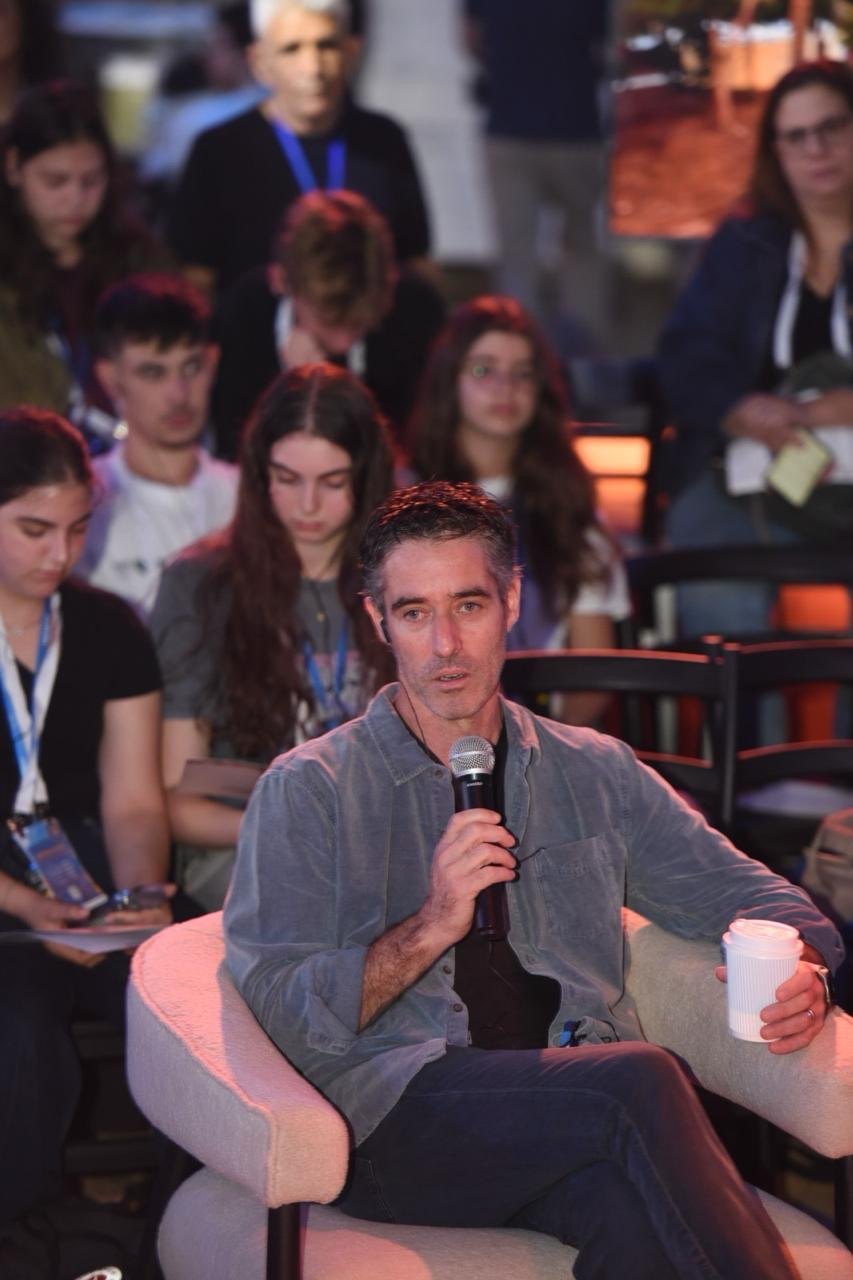
Nir Zohar, the president of Wix, said on Monday that within ten years every child in Israel will take part in an education program that is "a national project in its own right", and that he and his partners might "even own a network of schools." He spoke at Tetaru Lachem ("Imagine"), an international education conference held at Hangar 11 in Tel Aviv Port, in a session on the tech industry mobilizing for the next generation. Fiverr CEO Micha Kaufman spoke alongside him.
Now in its third year, the conference is organized with eight foundations active in Israeli education, among them the Trump Foundation, the Husidman Foundation, the Shashua Family Foundation, the Pozen Foundation, the Next Generation Fund, the HaBayta Foundation and the Maimonides Fund's Future Scientists Center. This year it focuses on the "here and now" of school: the work of teaching and practical steps to help teachers and students prepare for a future shaped by technological and social change. The audience included educators, academics, tech executives and teenagers. The Zohar and Kaufman session was moderated by the Next Generation Fund.
Kaufman was candid about the starting point. "Our philanthropy began with existential anxiety. Anxiety for the country, for what is happening here. That is a good motivation," he said. The sense that Israel was in "a kind of vertical dive toward the ground," he said, led him and his partners to conclude that they had to act "for the whole country and for our families, our children, so that there will be another generation here." He added that they had also had "a lot of luck," and that this was where their search for meaningful work began.
Kaufman said he was thinking "at the level of aspiration," and that the goal might sound too big, but he hopes that within a decade the next generation will contribute significantly to eliminating Israel's periphery. "I don't think there is any justification for a periphery in such a small country. This whole country is the size of one metropolitan area in the US," he said. The path, in his view, runs through education and creating opportunity, and socially he hopes for "a homogeneous majority with a lot of pluralism" that shares a love for the place and a will to prosper.
Kaufman said there is "endless philanthropy and social work in tech," even though the industry is not in a good place right now. "The tech industry is going through a major upheaval, and after it went through the judicial overhaul, when a lot of foreign investors pulled their money out of Israel, that complicated everything," he said. What drives him and his partners, he said, is the wish to "be a lighthouse" and show the way: "How not to think small, but to think big and as fast as possible."
Zohar began by saying that "at no point did we say, 'it's time we did philanthropy.'" Every entrepreneur, he said, needs two traits: being "terribly optimistic," and refusing to accept reality as it is, a trait he called "very Israeli." He described a wave of Israeli tech companies in the late 2000s that wanted to grow and build big things rather than sell, which produced founders with more resources than before. "There is one more lovely thing about Israeli tech: we are all friends. Even if we compete, we are still friends," he said.
According to Zohar, several company leaders got together to work out what they would do jointly. "We understood pretty quickly that we didn't want to find one-off projects," he said. "Our understanding was that the broad national infrastructure that can cause generational change and move and connect entire communities is education, and only education." He described the vision for the next decade as a set of programs from age three to after military service, mostly informal education and supplements to formal schooling. "Maybe we will even own a network of schools, I won't promise we won't, but each of these programs will be at a scale that reaches every child who wants it," he said, adding that Israel is "very poor in natural resources, and very rich in human resources."
Zohar said the past few years have been "a crazy upheaval" for the country, but compared them with its early days. Israel, he said, rose out of the Holocaust in Europe at a time that was far worse than today, and during the Yom Kippur War his parents felt an existential fear that it could all end. "That was a much harder reality than what we have experienced. And a decade or two later, the country flourished. So I am very optimistic," he said.
Both speakers come from Israeli public companies that are going through change of their own. Wix announced this month, with its third-quarter results, that Zohar is becoming co-CEO alongside founder Avishai Abrahami, as its Base44 platform approaches $250 million in annual recurring revenue. Kaufman's Fiverr, by contrast, reported a drop of about a quarter in active buyers and has warned that AI is eating into the freelance market.


